
KathaTrace: Diagnosing Semantic Trajectory Collapse in Generated Visual Narratives
Under submission to a CORE A* venue · arXiv preprint, 2026
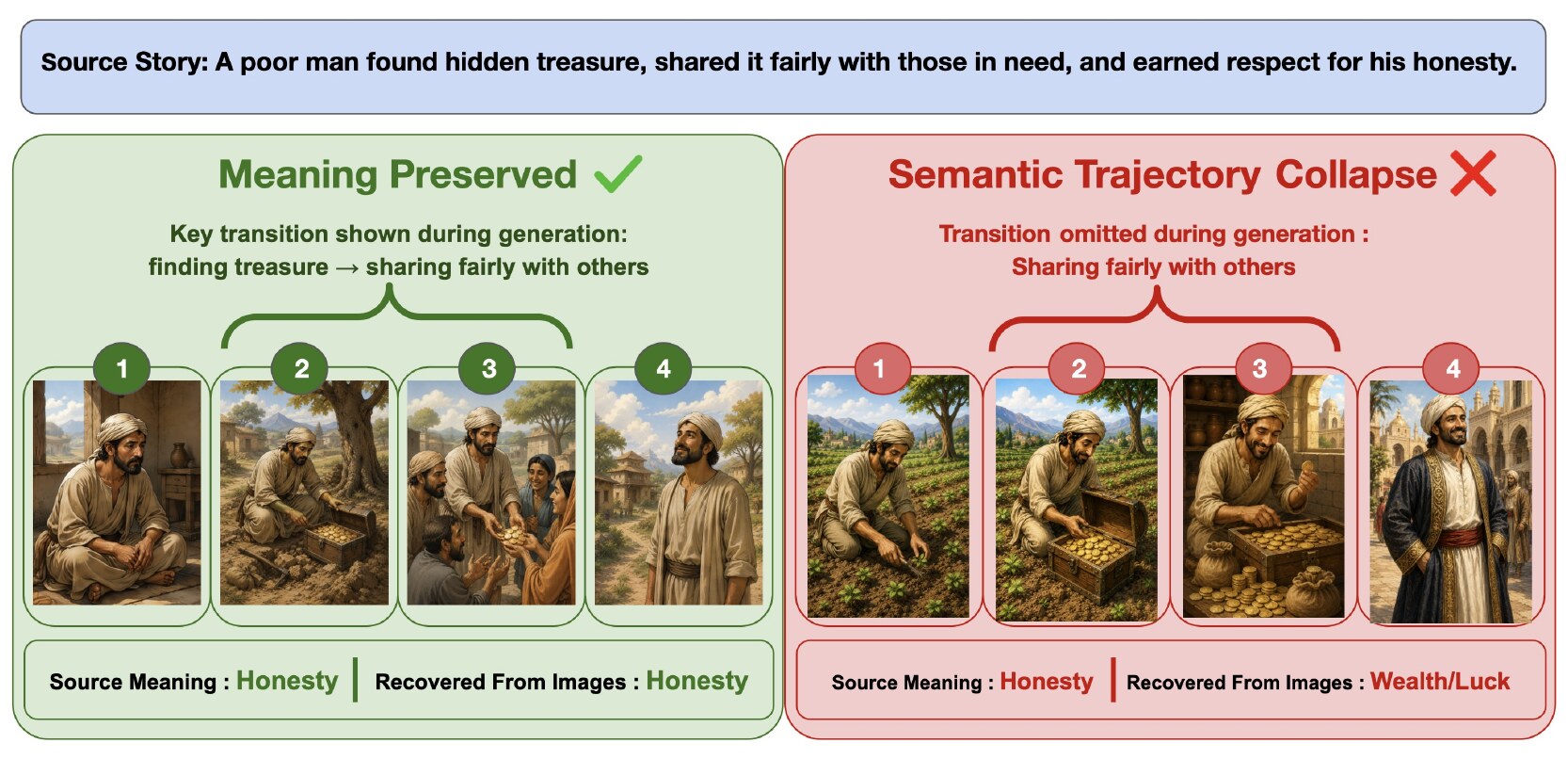
Visual narratives are central to storyboards, comics, children’s media, and film previsualization, where viewers must understand a story from images alone. Story generators such as StoryDiffusion produce coherent sequences, but visual coherence does not guarantee that the source story’s transition meaning remains recoverable. KathaTrace is a generator-agnostic protocol for diagnosing this failure — semantic trajectory collapse — by evaluating each transition under three evidence conditions (text-only, image-only, and text+image) and filtering ambiguous items.
The paper contributes KathaBench-25K: 5,000 narratives from classical collections (Aesop, Panchatantra, Kathasaritsagara), 20,000 transitions, and 28,712 recoverability questions. It defines the Semantic Trajectory Gap (STG) as text-only minus image-only recoverability — the transition meaning lost during visualization. Human validation yields Fleiss’ κ = 0.845, and state-of-the-art generators show a substantial STG (23.5 ± 1.3). Semantic Compass, an actionability probe, uses KathaTrace signals for post-generation repair and improves storyboard selection.