
Multimodal Humor Detection in Videos via Domain-Specific Representations and Deep Hybrid Fusion Networks
Soft Computing (Springer Nature), 2026
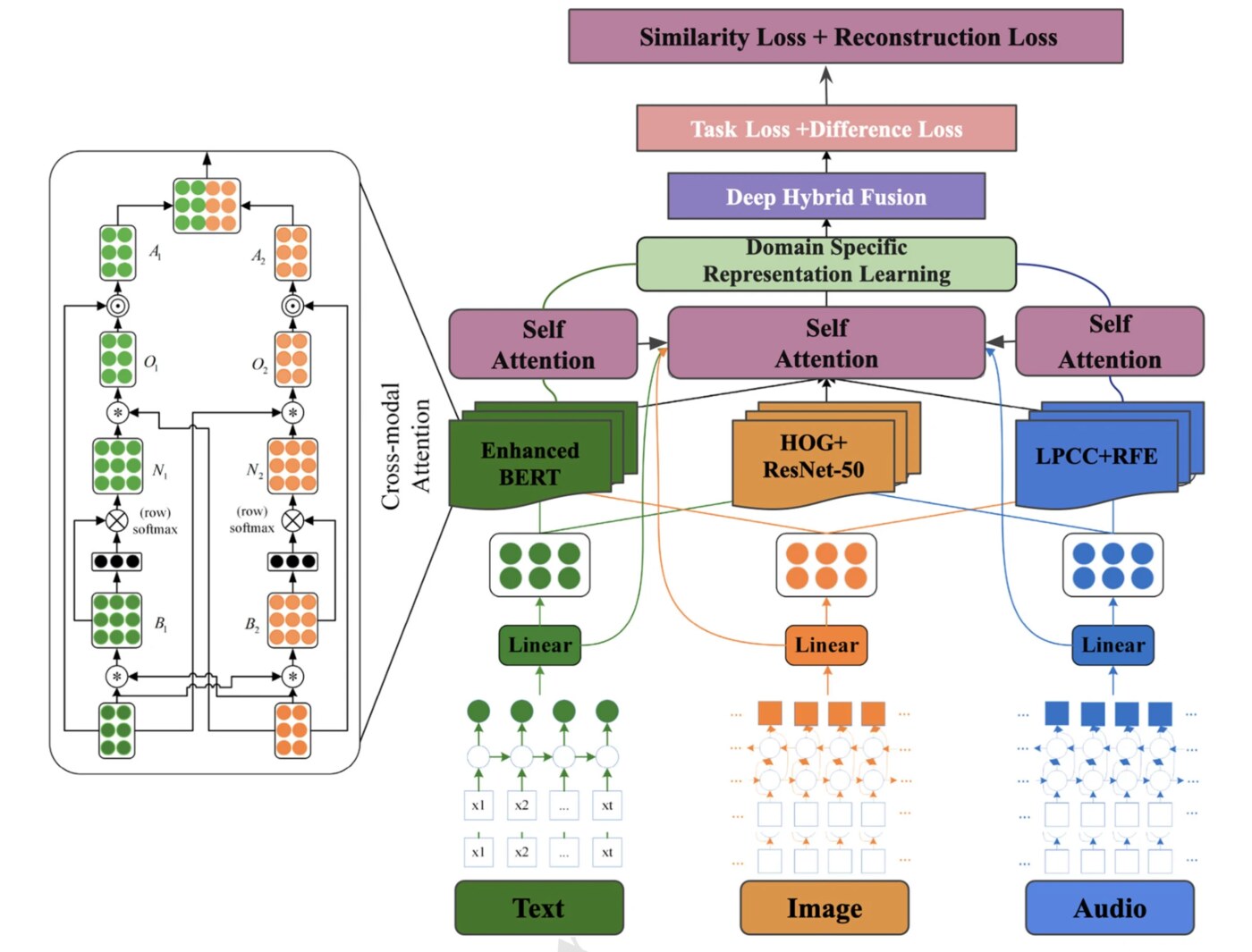
Multimodal data analysis plays a pivotal role in understanding human-centric content by integrating text, visual, and audio cues. Humor detection in videos remains particularly challenging because of temporal misalignment across modalities, data imbalance, and noise in real-world signals.
The proposed framework combines Domain-Specific Representation Learning (DSRL) with a Deep Hybrid Fusion (DHF) network. Text is encoded with an enhanced BERT, images with HOG and ResNet-50 features, and audio with LPCC features and recursive feature elimination. The Bi-LSTM-based DSRL module disentangles modality-invariant and modality-specific features, and DHF integrates them through self-attention and cross-modal attention with suppression mechanisms, trained with task, difference, similarity, and reconstruction losses.
Experiments on IEMOCAP, CMU-MOSI, and CMU-MOSEI show that the model outperforms state-of-the-art baselines, reaching up to 95.8% accuracy. Ablation studies and precision–recall analyses confirm the robustness and efficiency of the framework, and the paper discusses ethical considerations and deployment challenges for real-world humor recognition.
Received 29 July 2024 · Accepted 21 September 2026.